
How trench coat layering works for changing fall weather

Advertisement
Trench coat layering works by relying on an exterior shell to deflect wind and rain while using modular inner garments to regulate your core temperature as the day warms up or cools down. Rather than counting on a single heavy coat to provide all insulation, this approach divides thermal control across distinct garments that you can add or remove.
This method helps commuters, students, and budget-conscious dressers navigate brisk morning walks and balmy afternoons without purchasing different coats for every forecast shift. The primary catch is that successful layering requires careful attention to shoulder seams, armhole depth, and garment thickness to prevent fabric from bunching awkwardly beneath the coat.
Understanding shell fabrics and wind protection
A trench coat serves primarily as a protective barrier rather than an insulating furnace. Most traditional versions rely on tightly woven cotton gabardine, water-resistant cotton twill, or polyester-blend textiles. These fabrics were developed historically for military use in wet, windy conditions, and that utilitarian heritage remains their greatest strength today. When wind cuts through porous knitwear, your body loses heat rapidly through convection. By placing a tightly woven shell over your clothing, you trap an envelope of still air around your torso, which dramatically increases the warmth of lighter undergarments.
Advertisement
Polyester and nylon blends, which are common across budget-friendly retail brands, often offer superior wind resistance and water repellency compared to untreated cotton. However, synthetic shells allow less air permeability. If you walk quickly or enter an overheated subway car, a non-breathable shell can trap perspiration against your inner layers. Cotton twill breathes more naturally but may absorb moisture in sustained downpours unless it carries an explicit water-repellent coating. Knowing the composition of your trench coat shell allows you to choose undergarments that either maximize moisture evaporation or prioritize thermal retention.
The structural details of the coat also play an active mechanical role in temperature regulation. The storm flap across the chest adds an extra layer of fabric over the heart and lungs, while the throat latch secures the collar against sudden drafts. Sleeve straps can be tightened around the wrists to keep cold air from drafting up your arms during early hours, then loosened later in the day to encourage interior airflow.
Selecting the right base layers for thermal stability
The foundation of effective trench coat layering begins directly against the skin. In transitional seasons, temperature swings of twenty degrees between sunrise and mid-afternoon are routine. If your base layer is too thick or holds onto moisture, you will feel clammy as soon as the sun breaks through the clouds. The ideal base layer moves perspiration away from the skin while feeling comfortable if worn alone inside a warm room.
Fine-gauge fabrics and natural fibers generally perform best for this job. Ribbed cotton tanks, lightweight long-sleeve modal tees, and ultra-fine merino wool tops give you flexibility. Merino wool is especially useful because its crimped fibers trap insulating air pockets in the cold, yet it naturally regulates body temperature and resists odors when the environment heats up. Smooth supima cotton crewnecks also work well, provided the fabric is dense enough to hold its shape once the outer layers come off.
Effective base layer fabrics for autumn
- Lightweight merino wool: Regulates core temperature naturally without creating visual bulk under tailored shoulders.
- Long-staple cotton: Provides soft breathability and holds its structure when worn indoors without an overcoat.
- Lyocell and modal blends: Drape cleanly against the body, dry quickly, and slide smoothly against outer fabrics.
- Silk-knit tops: Offer high thermal efficiency relative to their whisper-thin profile, making them ideal under tight sleeves.
Adding modular mid-layers for flexible insulation
The mid-layer provides the actual warmth that a classic unlined or lightly lined trench coat lacks. The objective is to pick garments that add heat without restricting your range of motion through the shoulders and elbows. Because the trench coat blocks the wind, mid-layers do not need to be heavy or windproof themselves; they only need to hold warm air close to your body.
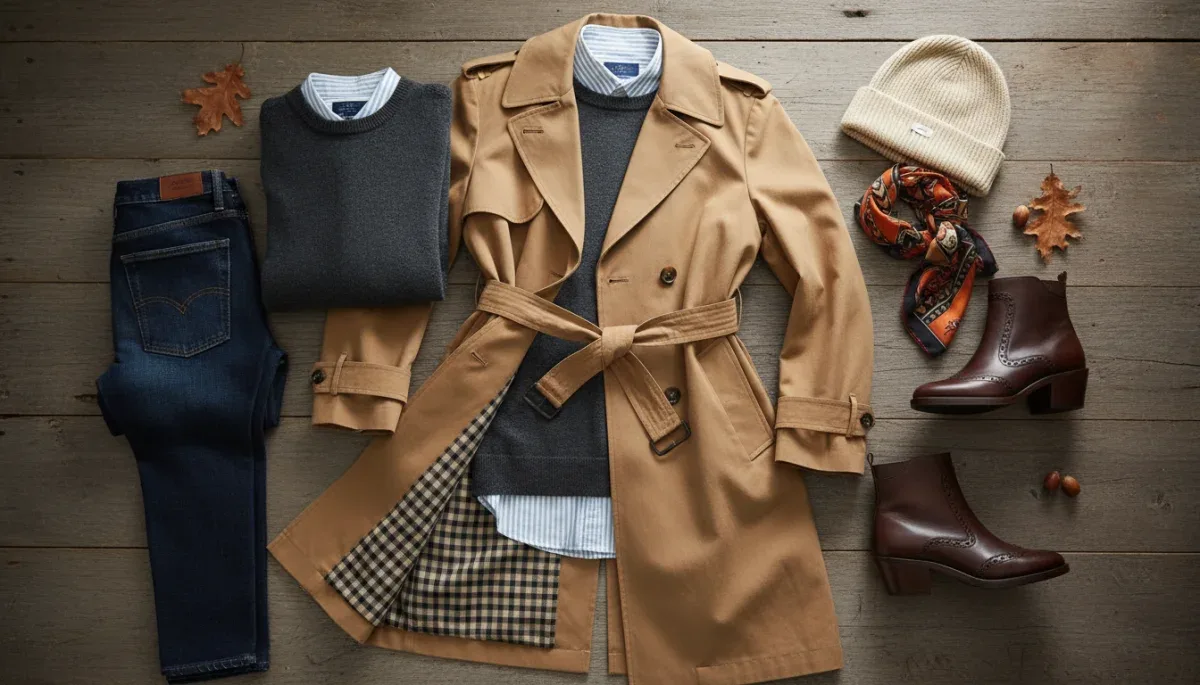
Cardigans, lightweight crewneck sweaters, and tailored blazers are classic choices that look intentional in professional and casual settings. A thin V-neck sweater worn over an open-collar oxford shirt creates a clean, classic aesthetic while giving you three distinct temperature adjustments: coat off, sweater off, or sleeves rolled. If the forecast calls for near-freezing morning temperatures, ultra-light down vests or quilted synthetic liners can be worn directly under the coat. These packable vests fold down into a compact pouch that fits into a work bag once the midday sun warms the air.
When using blazers as a mid-layer, verify that the trench coat has sufficient room through the upper back. A soft, unconstructed blazer made from wool flannel, ponte knit, or corduroy moves more comfortably beneath an outer shell than a rigid, heavily padded suit jacket. The collar of your mid-layer should sit comfortably flat beneath the lapels of the trench coat to prevent excess fabric from pressing against your neck.
Managing armhole cut and shoulder proportions
The physical fit of your trench coat determines how many garments you can comfortably wear underneath it. Many modern trench coats are designed with a slim silhouette and high armholes to look flattering over a simple T-shirt. However, high armholes and narrow sleeves make wearing chunky sweaters or structured blazers nearly impossible, resulting in tight fabric that restricts your arm movements and pulls the coat out of alignment.
If you plan to use a trench coat throughout late fall, consider how the sleeves are attached. Trench coats typically feature either set-in sleeves or raglan sleeves. A set-in sleeve has a vertical seam running over the point of the shoulder, creating a structured, formal profile. A raglan sleeve extends in one continuous piece from the collar down to the underarm, leaving a diagonal seam across the chest. Raglan sleeves provide significantly more room for layered knits and suit jackets because there is no rigid shoulder seam to bind against your garments.
When shopping for a seasonal trench coat on a budget, sizing up by one size can often transform a restrictive coat into a versatile layering piece. If you size up, check that the coat belt can still cinch the waist neatly to preserve proportion. A coat that fits slightly relaxed through the torso gives you the freedom to wear anything from a silk blouse to a heavy cable-knit sweater without altering the outer drape of the garment.
Coordinating trousers, skirts, and autumn footwear
A trench coat covers a significant portion of your outfit, which means your choice of bottom pieces and footwear dictates whether the overall silhouette appears balanced. Because fall weather often brings wet leaves, puddles, and damp sidewalks, your lower garments must be as practical as your coat shell.
Straight-leg denim, wool trousers, and tailored chinos provide clean vertical lines that complement the length of a mid-calf or knee-length coat. If your trench coat is long, wide-leg trousers can create an elegant, sweeping line, provided the hem does not drag on wet pavement. For skirts and dresses, aim for a hemline that either sits distinctly above the bottom of the coat or extends several inches past it. An awkward overlap where the skirt hem lands right at the coat line can create an unintentional, cluttered transition.
Footwear pairings for wet and dry conditions
- Leather ankle boots: Provide water protection while keeping the ankle profile narrow under wide-leg or straight trousers.
- Low-profile loafers: Work well for mild, dry afternoons when paired with ankle-length chinos or dark denim.
- Chelsea rain boots: Offer durable waterproofing in heavy rain while maintaining a sleek, tailored shape beneath coat hems.
- Classic leather sneakers: Create a relaxed weekend look that balances the formal tailoring of a double-breasted coat.
Styling adjustments for shifting daily temperatures
Knowing how to wear and adjust your trench coat throughout the day is just as important as the items you put beneath it. A single outfit can be styled in multiple ways between 8:00 AM and 5:00 PM to react to changes in ambient heat, humidity, and activity levels.
During the coldest part of the morning, button the coat completely, fasten the belt buckle, and turn up the collar to shield your neck from drafts. Fastening the belt holds the fabric close against your torso, minimizing the internal air volume that your body needs to keep warm. If you are wearing a scarf, tuck it inside the lapels before buttoning the front to form a continuous seal.
By early afternoon, when temperatures climb, you can loosen the structure entirely. Unbutton the front and tie the belt in a relaxed knot behind your back. Tying the belt in the rear pulls the side panels back, creating an open front that vents warm air while maintaining a clean, tapered waistline. If the weather becomes genuinely warm, you can remove the trench coat altogether and carry it draped over your arm or folded over a tote bag. Because trench coat fabrics are durable and relatively wrinkle-resistant, the garment handles frequent transitions without losing its tailored appearance.
At a glance
| Layering element | Primary function |
|---|---|
| Shell fabric | Blocks external wind and dampness to preserve internal trapped warmth. |
| Raglan sleeve cut | Provides shoulder clearance for knitwear and blazers without fabric bunching. |
| Merino base layer | Wicks moisture while maintaining core temperature stability indoors and out. |
| Packable mid-layer | Adds optional insulation for chilly mornings and stores easily during warmer hours. |
Frequently asked questions
Can you wear a chunky sweater under a trench coat?
Yes, but only if the coat has generous armholes and wider sleeves. A raglan sleeve cut accommodates thick knitwear much better than a tight, set-in shoulder seam, which tends to bind and restrict arm movement when paired with heavy wool.
Should I size up when buying a trench coat for fall?
Sizing up is advisable if you plan to wear blazers, heavy cardigans, or quilted liners underneath. A slightly larger size provides the necessary chest and shoulder clearance, while the waist belt allows you to cinch the silhouette when wearing lighter base garments.
Is a cotton or polyester trench coat better for layering?
Polyester blends generally offer better wind resistance and dry faster, making them efficient outer shields over warm knits. Cotton twill breathes better indoors, which helps prevent sweat accumulation if your daily routine involves moving frequently between cold sidewalks and heated buildings.
How do I stop my neck from getting cold without a winter coat?
Use the built-in throat latch to close the collar fully, or add a lightweight wool or silk scarf tucked inside the lapels. The trench coat shell blocks cold drafts, while the scarf traps body heat directly around the exposed neck and upper chest.
The bottom line
Trench coat layering is one of the most cost-effective strategies for dressing through unpredictable autumn temperatures because it turns an unlined outer shell into a multi-season wardrobe staple. By relying on wind resistance rather than heavy bulk, you can adapt quickly to changing forecasts using standard knits, shirts, and packable vests. Before purchasing a new coat or styling an existing one, check the armhole depth and shoulder seam placement while wearing your thickest planned autumn sweater to confirm you have full mobility.
Written by
Mariana Viana
Mariana Viana writes about seasonal fashion trends and celebrity style steals for news4shein.com. Each article explains how things work, compares published details such as prices, policies and program rules, and points readers to the official source before they decide.