
How bridal fashion week designs reach off-the-rack boutiques
Advertisement
Runway presentations at New York Bridal Fashion Week establish the aesthetic direction for future wedding gowns by introducing dramatic silhouettes, experimental textiles, and fresh styling choices. For shoppers planning a wedding on a modest budget, these high-fashion collections do not stay confined to couture ateliers; they steadily migrate into accessible ready-to-wear storefronts through calculated adjustments in materials, patterning, and global manufacturing. Understanding how these runway ideas filter down into retail stores helps brides identify emerging elements early, evaluate garment construction, and time their purchases effectively.
This design transfer benefits budget-conscious shoppers who want the look of current designer collections without paying custom couture prices, but the trade-off involves differences in construction details and fabric composition. Commercial apparel brands must balance runway appeal with mass-market production realities, adapting intricate handwork into machine-sewn garments that fit standard size charts. By tracking how bridal fashion week designs move from runway presentations to showroom samples and finally to retail racks, shoppers can distinguish between fleeting novelty cuts and durable construction values.
The seasonal timeline of bridal runway translation
Bridal Fashion Week takes place twice a year, primarily in April and October, serving as an industry trade event where luxury houses present their upcoming collections to boutique buyers, editors, and commercial manufacturers. Unlike standard ready-to-wear fashion cycles that shift every few months, the bridal sector operates on an extended lead schedule dictated by traditional wedding planning timetables and manufacturing constraints. When a luxury designer unveils an original concept on the runway, wholesale buyers and commercial product developers immediately evaluate which details hold broad commercial appeal.
Advertisement
The journey from the runway stage to an off-the-rack hanger generally spans nine to eighteen months. During the first two months following the shows, mass-market bridal manufacturers analyze trend reports and consumer feedback to build derivative sketches. Wholesale purchase orders are placed six months ahead of store deliveries, allowing factories overseas to prepare production lines. Off-the-rack bridal boutiques receive these commercially adapted collections just as newly engaged shoppers begin booking try-on appointments for the subsequent wedding season.
Key stages in the production schedule
- Runway presentation: Designers showcase concept pieces to press and commercial retail buyers during spring and autumn industry weeks.
- Commercial prototyping: Manufacturers create simplified patterns, test everyday fabrics, and adjust closures for mass sizing.
- Wholesale ordering: Independent boutique owners view showroom samples and select standard-sized inventory for upcoming store deliveries.
- Retail distribution: Finished garments arrive on boutique racks roughly nine to twelve months after their initial runway debut.
Material substitutions and fabric engineering
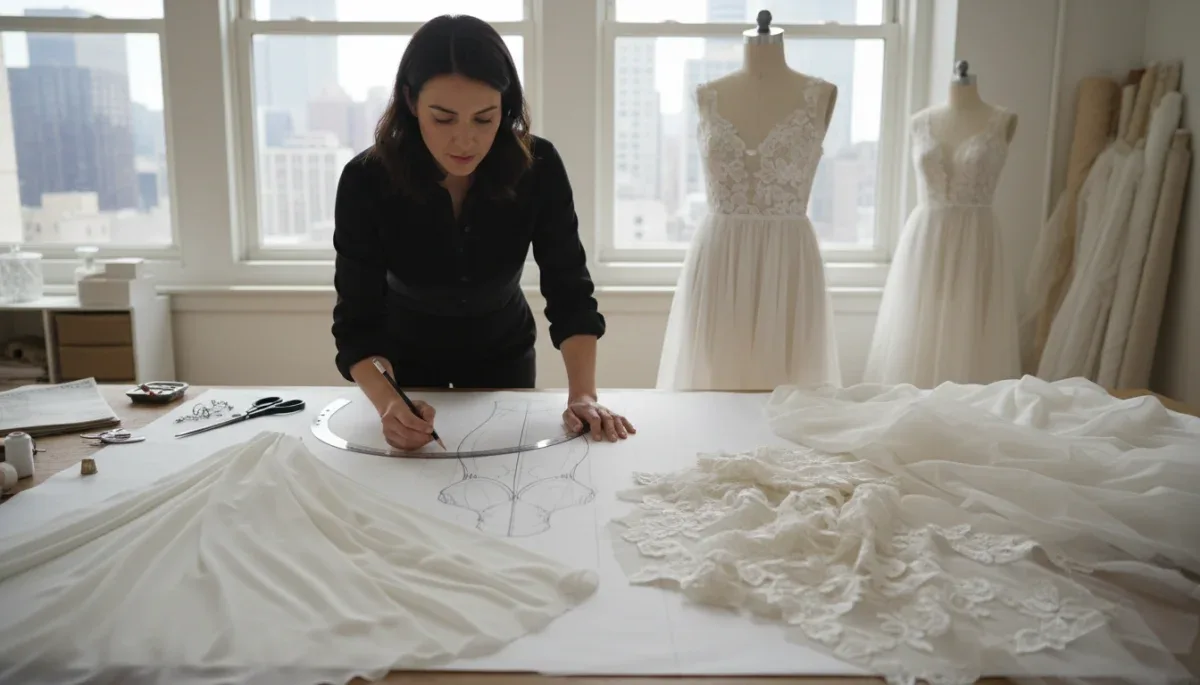
The most immediate difference between couture bridal fashion week designs and off-the-rack boutique gowns lies in the choice of raw materials. Haute couture pieces rely heavily on luxury textiles such as pure silk mikado, handmade French Chantilly lace, heavyweight silk zibeline, and real silk organza. These textiles cost hundreds of dollars per yard and require specialized hand-cutting, steam-shaping, and delicate stitching that would render ready-to-wear gowns unaffordable for typical retail shoppers.
To recreate the visual weight and drape of luxury textiles at consumer price points, commercial manufacturers turn to engineered synthetic fibers. High-grade polyester blends have advanced significantly, enabling mills to simulate the structure of silk faille or the fluid drape of silk crepe using polyester crepe de Chine. Similarly, intricate handmade laces are replicated using computerized embroidery machines on nylon mesh, mimicking the floral motifs of heirloom lacework with uniform precision.
While these synthetic fabrics deliver a comparable visual profile under natural light and indoor flash photography, they behave differently against the body. Polyester weaves lack the natural breathability and moisture-wicking qualities of organic silk, making them noticeably warmer during outdoor summer ceremonies. However, synthetic fabrics offer greater resistance to creasing and stretching, which ensures that off-the-rack samples withstand repeated customer try-ons without losing their tailored silhouette.
Simplifying construction and structural foundations
Runway gowns achieve dramatic silhouettes through complex inner architecture, including custom-molded steel boning, waist stay ribbons, layered horsehair hem braids, and multi-piece interior corsetry. These foundations are hand-sewn to individual body measurements, creating an architectural fit that distributes the heavy weight of full skirts across the wearer's hips. In high-fashion pieces, this interior work accounts for a substantial percentage of the overall labor hours.
When apparel brands adapt bridal fashion week designs for off-the-rack production, they re-engineer internal support systems to fit standard industrial sizing and automated assembly lines. Rigid steel boning is replaced with flexible plastic boning channels that flex easily across various torso lengths. Layered crinoline underskirts are integrated into standard waistband seams rather than mounted on detached internal girdles, streamlining the garment assembly process while preserving the desired exterior volume.
Common structural adaptations in ready-to-wear gowns
- Plastic boning: Replaces traditional spiral steel stays to reduce garment weight, lower production costs, and simplify machine sewing.
- Concealed zipper closures: Replace functional rows of hand-looped silk buttons, using decorative faux buttons along the zipper seam instead.
- Standardized seam allowances: Narrower interior seam margins reduce waste fabric during bulk cutting, leaving less room for extensive alterations.
- Merged linings: Combines petticoats and modesty layers directly into outer skirt seams to eliminate multi-layer hand basting.
Translating embellishments from hand embroidery to machine applications
Intricate embellishment is a signature element of bridal runway presentations, featuring thousands of hand-applied glass seed beads, freshwater pearls, Swarovski crystals, and three-dimensional fabric appliqués. A single runway showpiece can require weeks of dedicated artisan labor to apply beadwork across sheer illusion mesh. For off-the-rack collections intended to retail at standard price points, brands must capture the texture of these elements without accumulating hundreds of hours of manual handcraft.
Commercial design teams achieve this through mechanized manufacturing techniques, such as laser-cut lace appliqués, heat-transfer bead placements, and pre-beaded lace rolls. Instead of applying individual beads to a finished dress bodice, manufacturers purchase continuous yardage of pre-embellished tulle that is cut directly into standard pattern pieces. Appliqués are frequently attached using industrial zig-zag lockstitches or textile bonding adhesives rather than invisible hand knots, maintaining structural durability while drastically lowering manufacturing time.
For the retail shopper, these production adjustments mean that ready-to-wear gowns offer the dimensional look of runway garments while maintaining manageable price points. The primary limitation involves pattern continuity: hand-beaded couture gowns integrate motifs seamlessly across bodice seams, whereas mass-produced versions may show visible pattern breaks at the side seams or zipper line where pre-embellished panels meet.
Commercial adjustments to neckline and silhouette trends
Runway designers deliberately exaggerate silhouettes to ensure their creative concepts translate clearly across camera lenses and expansive runway stages. Deep plunging necklines that drop past the ribcage, sheer unlined bodices, ultra-high leg slits, and cathedral-length sweep trains serve as editorial artistic statements. While these runway concepts generate press coverage, most brides prefer garments that provide modesty, support, and practical mobility for an all-day event.
Off-the-rack boutiques rely on commercial buyers to select adapted versions of these exaggerated silhouettes. When a plunging neckline trend sweeps bridal fashion week designs, retail manufacturers interpret the look by adding sheer illusion mesh panels, raising the bottom apex of the plunge by two to three inches, or offering detachable modesty panels. Similarly, unlined illusion bodices presented on the runway are mass-produced with optional soft jersey lining to accommodate standard strapless bras or sewn-in molded cups.
Train lengths undergo similar functional reductions during the commercial transition. Runway trains measuring ten feet or more are scaled back to practical chapel or court lengths in off-the-rack inventories. This reduction not only saves yardage and manufacturing costs, but it also ensures that the gown can be quickly bustled by a local tailor, allowing the bride to move comfortably throughout an evening reception without carrying excessive fabric weight.
How regional boutiques curate ready-to-wear collections
Independent bridal salon owners act as the final editorial filter between international runway presentations and local shoppers. Boutique buyers attend market showcases held alongside Bridal Fashion Week to review adapted showroom samples from wholesale bridal labels. Rather than stocking every runway novelty, these shop owners curate inventory based on the regional preferences, climate conditions, and typical venue styles of their local clientele.
A bridal boutique in an urban setting may focus inventory on adapted architectural column gowns and tailored crepe jumpsuits, whereas a suburban boutique serving outdoor garden venues might invest heavily in romantic tulle skirts and floral lace appliqués. Because off-the-rack boutique samples must appeal to a wide variety of body shapes, store buyers select styles engineered with flexible interior construction that flatters standard sample sizes between size eight and size eighteen.
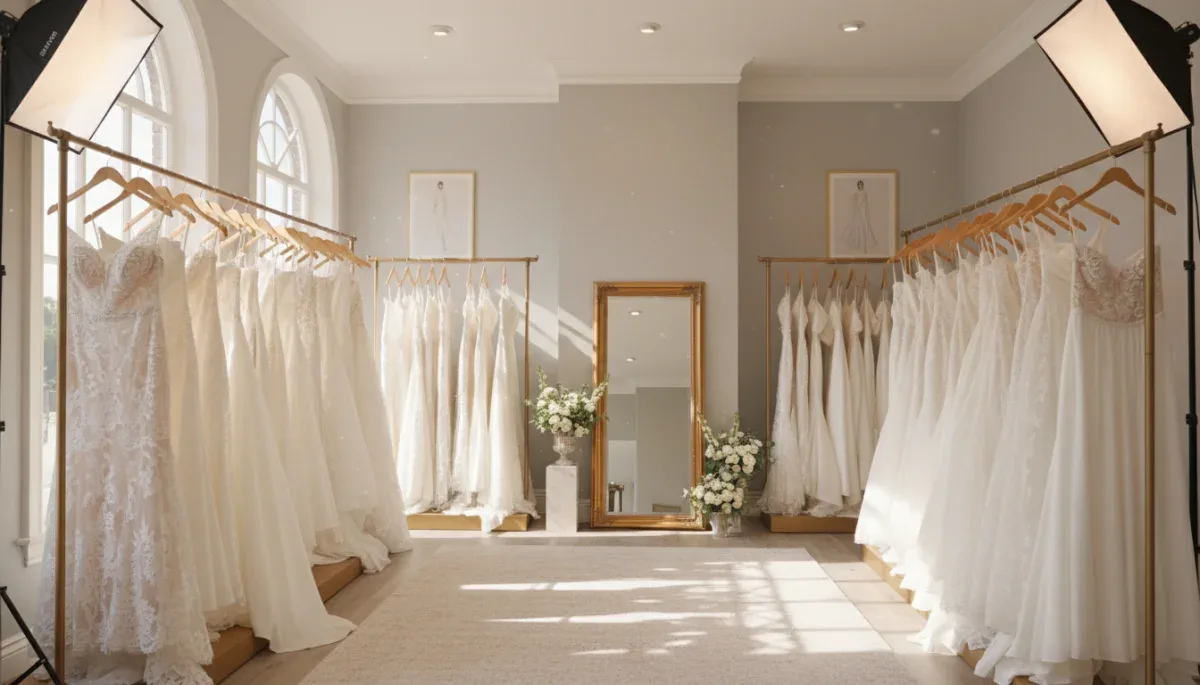
Shoppers browsing off-the-rack racks encounter the polished, wearable outcome of this multi-tiered filtering process. The gown hanging on the boutique rail reflects the overarching theme and styling cues of the original runway collection, yet it has been refined to fit commercial production budgets, practical wearability demands, and standard bridal alterations.
At a glance
| Factor | What to know |
|---|---|
| Retail arrival | Runway design elements reach off-the-rack boutique racks within nine to eighteen months after their fashion week debut. |
| Fabric composition | Natural silks and hand-loomed laces are substituted with engineered polyesters and machine-embroidered nylon blends. |
| Structural support | Heavy custom steel boning and hand-stitched inner corsets are replaced with machine-sewn plastic boning and standard linings. |
| Silhouette modifications | Exaggerated runway necklines and sheer panels are modified with raised plunge lines, modesty meshes, and manageable train lengths. |
Frequently asked questions
Why do off-the-rack dresses look slightly different from runway photos?
Commercial manufacturers modify runway gowns to ensure they can be mass-produced efficiently and fit standard body sizes. This involves substituting luxury textiles with synthetic blends, replacing hand embroidery with machine work, and adjusting extreme necklines or train lengths to improve everyday wearability and structural support during real wedding events.
How long after Bridal Fashion Week do new styles hit retail stores?
New styles typically arrive on retail boutique racks between nine and eighteen months after their runway showcase. This production interval allows commercial manufacturers to draft commercial patterns, produce showroom samples, gather wholesale buyer orders, and complete factory production runs before distributing finished dresses to independent bridal salons.
Are synthetic bridal fabrics noticeably inferior to natural runway silks?
Synthetic bridal fabrics are not necessarily inferior, though they offer distinct physical characteristics compared to pure silks. Modern polyester crepes and mikados reproduce the visual drape and structure of natural silk closely on camera while resisting wrinkles, though they offer less airflow and breathability than natural fibers in warm conditions.
Can a tailor alter an off-the-rack gown to look more like the runway original?
A skilled bridal alterations specialist can adjust certain details, such as lowering a neckline, removing modesty panels, or changing buttons, to mimic runway styling. However, a tailor cannot alter the base fabric composition or replace internal machine-stitched foundations without performing costly, extensive reconstructive labor on the gown.
The bottom line
Bridal Fashion Week serves as the creative foundation for future mainstream wedding trends, translating high-concept couture into wearable, cost-effective off-the-rack options through synthetic textile engineering, automated embroidery, and modest silhouette adjustments. This commercial transition makes contemporary bridal aesthetics widely accessible to brides shopping on standard timelines and budgets. Before purchasing an off-the-rack gown, inspect the interior seam allowances and boning channels in person to confirm that the dress can be altered comfortably to your exact measurements.
Written by
Rita Luiza
Rita Luiza writes about US fashion events, seasonal fashion trends and budget fashion tips for news4shein.com. Each article explains how things work, compares published details such as prices, policies and program rules, and points readers to the official source before they decide.